Why your "quick gamification sprint" will cost $250K+ and still need ongoing maintenance.
Your product manager comes to you with an exciting pitch: "Let's add gamification -- streaks, leaderboards, achievements. Duolingo does it. LinkedIn does it. Our retention numbers will skyrocket."
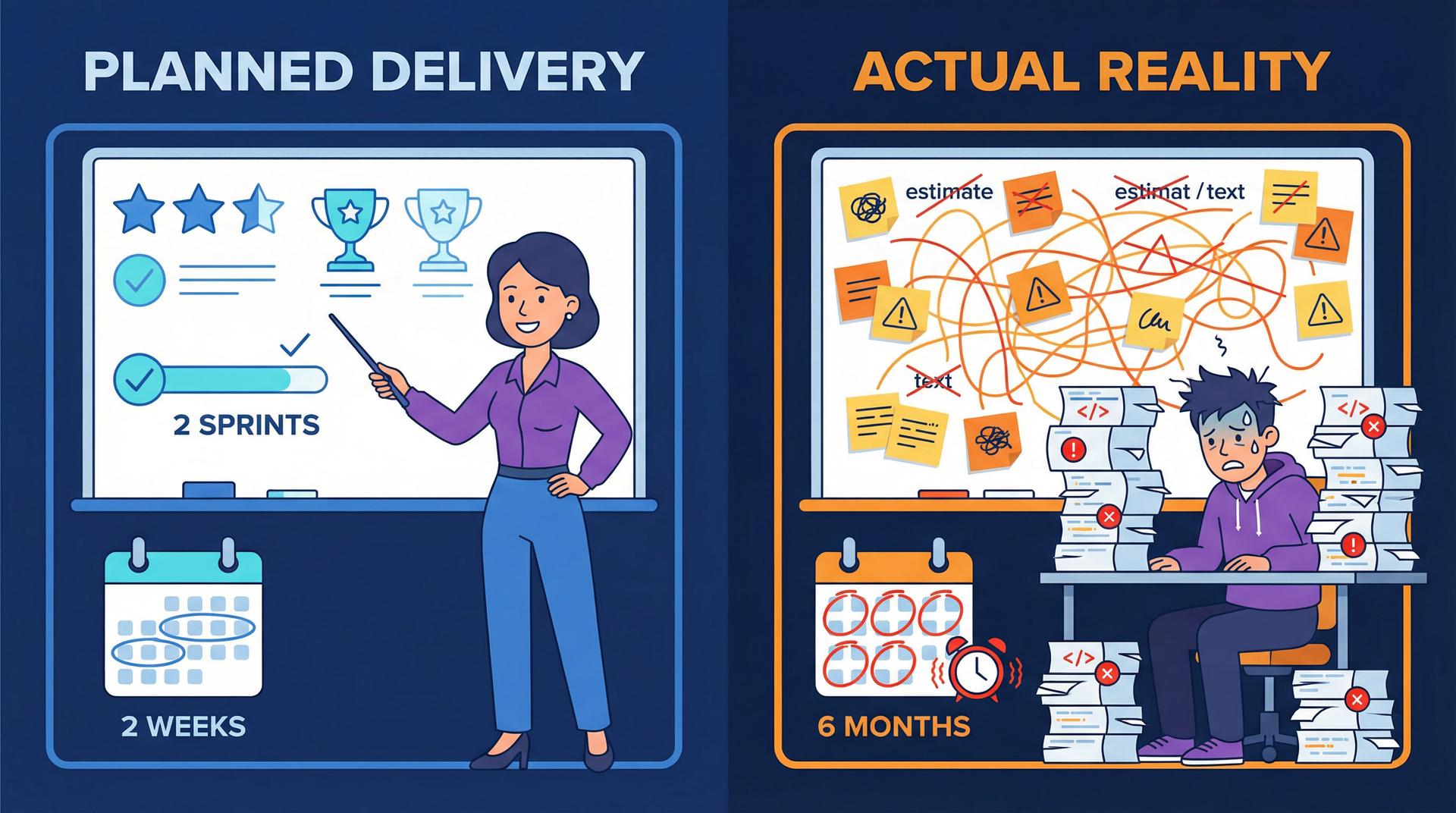
You open your project management tool, estimate two sprints, and assign a couple of engineers. How hard can it be? After all, it's just points and badges, right?
Wrong. Six months later, your "quick sprint" has consumed $250,000 in engineering time, your leaderboard breaks every daylight saving transition, and your anti-cheat measures are non-existent. Meanwhile, the features that actually differentiate your product -- the ones only your team can build -- have been sitting in the backlog collecting dust.
This isn't a hypothetical scenario. It's the reality that engineering teams discover after committing to building gamification from scratch. In this post, we'll break down every dollar, every hidden cost, and every trade-off -- so you can make the build-vs-buy decision with your eyes wide open.
The Visible Costs: What You Budget For
When teams estimate gamification costs, they typically account for developer salaries and a rough timeline. Let's start there, because even the "obvious" costs are larger than most teams expect.
Developer Salary Math
As of 2026, the average U.S. software engineer earns approximately $147,500 per year according to ZipRecruiter, which translates to roughly $71 per hour. Senior engineers -- the ones you need for architectural decisions on real-time systems, database design, and security hardening -- command $170,000 to $205,000+ annually.
Add employer costs (benefits, equipment, overhead) at 25-30% on top of base salary, and a mid-level engineer's fully loaded cost reaches $60,000-$100,000 for a six-month engagement. Senior involvement pushes that higher.
What "Basic" Gamification Actually Requires
Most teams start by scoping a "simple" feature set: points/XP, a leveling system, achievements, and a leaderboard. But even this minimal scope requires significant backend engineering:
- Player state management -- Tracking XP, levels, currencies, and progress for every user across sessions and devices
- Achievement/badge system -- Defining unlock conditions, tracking progress toward multi-step achievements, handling edge cases
- Leaderboard engine -- Sorted rankings with time windowing (daily, weekly, all-time), efficient queries at scale, tie-breaking logic
- Rules engine -- Event-driven automation to award XP or badges when specific actions occur, without hardcoding every rule
- API layer -- RESTful endpoints, authentication, rate limiting, input validation, error handling
- Admin interface -- Dashboard for your product team to configure mechanics without deploying code
- Database design -- Schema for multi-user state, historical tracking, efficient queries, data integrity
That's the minimum. Most teams realize mid-project that they also need quest/mission systems (guided user journeys), streak tracking with timezone handling, real-time notifications, and analytics to measure whether any of it is working. Each feature adds weeks or months to the timeline.
Initial Development Cost Breakdown
| Cost Component | Low Estimate | High Estimate |
|---|---|---|
| Backend Development (2-4 engineers, 3-6 months) | $100,000 | $300,000 |
| Frontend / Admin Console UI | $30,000 | $80,000 |
| Database Architecture & Optimization | $15,000 | $40,000 |
| Real-Time Infrastructure (WebSockets) | $20,000 | $50,000 |
| Security & Anti-Cheat Measures | $10,000 | $30,000 |
| QA, Testing, & Bug Fixes | $15,000 | $40,000 |
| Documentation & SDK Development | $10,000 | $25,000 |
| Project Management Overhead | $10,000 | $25,000 |
| TOTAL INITIAL DEVELOPMENT | $210,000 | $590,000 |
These figures align with industry analyses. Trophy.so's build-vs-buy research puts basic gamification at $100K-$160K for a minimal feature set, while comprehensive implementations with real-time events, quests, and analytics reach $250K-$500K+. Projects routinely run over budget as teams discover complexity they didn't anticipate during estimation.
The Hidden Costs: What Nobody Budgets For
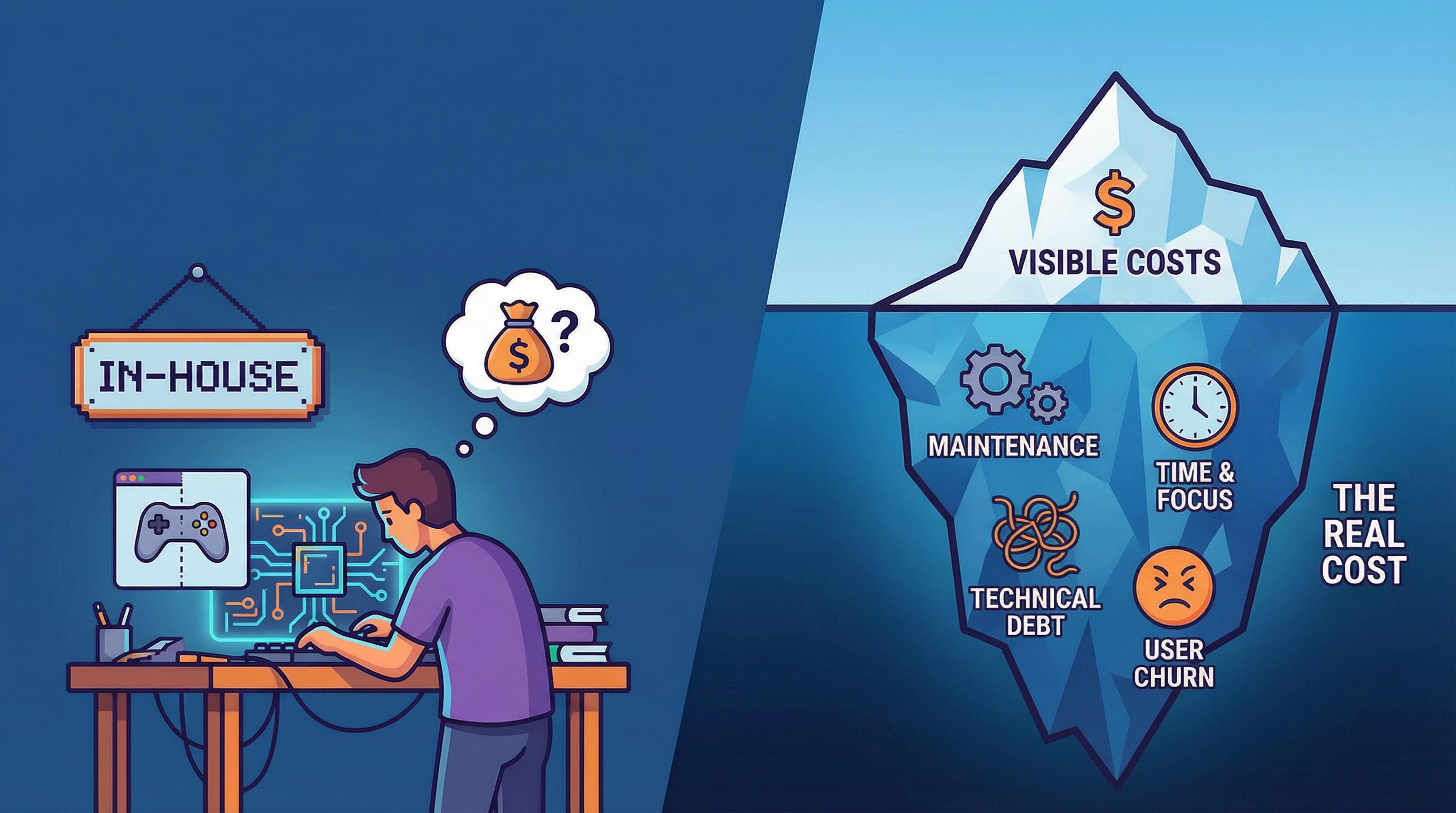
The initial build is just the tip of the iceberg. The costs that sink gamification projects are the ones that appear after launch and never stop compounding.
Infrastructure That Scales With Success
Gamification systems are uniquely expensive to operate because they grow in direct proportion to your product's success. Every active user generates continuous state updates, leaderboard recalculations, and event processing.
| Active Users | Monthly Infra Cost | Annual Cost |
|---|---|---|
| 10,000 users | $200 - $500 | $2,400 - $6,000 |
| 50,000 users | $800 - $2,000 | $9,600 - $24,000 |
| 100,000+ users | $3,000 - $5,000+ | $36,000 - $60,000+ |
These costs include database storage for user progress and historical data, compute resources for leaderboard calculations and event processing, caching infrastructure (Redis or equivalent) for real-time performance, and monitoring and logging to catch issues before users do.
The Maintenance Tax: 10-20% of Engineering Capacity, Forever
This is the cost that blindsides teams. Once your gamification system is live, it demands continuous engineering attention:
- Bug fixes and edge cases -- Users will discover scenarios you never tested. Streak logic that breaks at midnight in certain timezones. Achievements that double-award during race conditions. Leaderboards that return stale data under load.
- Feature evolution -- Your product evolves, and gamification needs to keep pace. New user actions worth rewarding, rebalanced point values based on behavioral data, new achievement thresholds -- each change requires code modifications and deployment.
- Performance optimization -- What works for 5,000 users will choke at 50,000. Leaderboard queries need progressive optimization. Caching strategies require refinement. Database indices need adjustment as data grows.
- Security patches -- Your gamification stack depends on frameworks and libraries. When vulnerabilities are disclosed, you patch on someone else's timeline, not yours.
- Integration updates -- Every change to your core product -- new features, modified user flows, updated APIs -- requires someone to verify gamification still works correctly.
Industry analyses consistently estimate this maintenance burden at 10-20% of a developer's annual capacity, translating to $15,000-$30,000 per year per engineer assigned. And this cost never ends.
The Timezone Nightmare
Properly handling timezones across global users is one of the most underestimated challenges in gamification engineering. Daylight saving transitions break streak logic every single time. Users crossing timezones lose daily progress. Edge cases keep appearing months after launch. This single problem has derailed more gamification projects than any technical limitation.
Timezone handling sounds trivial until you're debugging why 2,000 users in Arizona (which doesn't observe daylight saving time) lost their streaks at the same time users in neighboring states kept theirs. Solving this properly requires storing user timezone preferences, normalizing all timestamps to UTC with timezone-aware calculations, handling DST transitions gracefully, and testing against every timezone edge case globally. Most teams solve this reactively -- after angry users report lost progress.
The Opportunity Cost: What You're Not Building
This is the cost that doesn't appear on any spreadsheet, but it's often the most expensive of all.
Every engineer working on gamification infrastructure is an engineer NOT working on the features that differentiate your product. The unique capabilities that make users choose you over competitors. The innovations that drive your next funding round or revenue milestone.
Stripe didn't succeed because it built payments from scratch. It succeeded because it gave developers back the months they would have spent on payment infrastructure, letting them focus on their core products. The same principle applies to gamification: your competitive advantage lies in what makes your product unique, not in re-implementing engagement mechanics that are well-understood and commoditized.
Consider the math: if your two best engineers spend six months building gamification, that's six months of your most expensive, highest-impact talent diverted from your core product. At a typical startup burn rate, this opportunity cost can exceed the direct development costs.
The Failure Risk: Why 80% of Gamification Projects Don't Work
Even if you budget correctly and execute on time, there's a significant risk that your gamification implementation simply won't achieve its goals.
Gartner famously predicted that 80% of gamification projects would fail to meet business objectives, primarily due to poor design. The prediction has been widely validated. The causes are consistent:
- "Points and badges" syndrome -- Teams bolt on superficial game mechanics without understanding behavioral science. A leaderboard without meaningful progression. Badges nobody cares about earning. Points with no clear purpose. An estimated $700 million has been lost to failed U.S. gamification projects that took this one-size-fits-all approach.
- No measurement infrastructure -- Teams build the mechanics but not the analytics to determine what's working. Without cohort analysis, funnel tracking, and retention metrics, you're flying blind. You can't improve what you can't measure.
- Inability to iterate -- When gamification is hardcoded, changing a point value or achievement threshold requires a code deployment. Product teams can't experiment. By the time data suggests adjustments, engineering bandwidth isn't available to implement them.
- Employee resistance (enterprise) -- United Airlines' 2018 lottery-based employee rewards program backfired so severely that employee protests forced its abandonment. SHRM's Chief HR Officer warned that poorly designed gamification "can create challenges instead of driving positive outcomes."
The difference between the 20% that succeed and the 80% that fail comes down to iteration speed and measurement. Teams that can rapidly test different mechanics, measure outcomes, and adjust their approach without code deployments consistently outperform those locked into static implementations.
Timeline Comparison: Build vs. Buy
The speed gap is the part of the equation that surprises engineering leaders most.
| Milestone | Build In-House | Buy (API Solution) |
|---|---|---|
| First working prototype | 4-8 weeks | Same day |
| Basic features live (XP, badges) | 2-3 months | 1-2 days |
| Leaderboards + real-time updates | 3-4 months | 1 week |
| Quests and mission systems | 4-6 months | 1-2 weeks |
| Analytics and measurement | 5-7 months | Built-in from day one |
| Production-hardened + at scale | 6-12 months | Already production-ready |
| A/B testing mechanics | 8-12+ months | Available via admin console |
Every month your gamification isn't live is a month of user engagement you're not capturing. If your competitor ships engagement features in a week while you're still in month three of your custom build, they're accumulating compounding retention advantages you may never close.
Total Cost of Ownership: The 3-Year View
The build-vs-buy decision only makes sense when you look at the full picture over multiple years. Here's the total cost of ownership comparison:
| Cost Category | Build In-House (3yr) | API Platform (3yr) |
|---|---|---|
| Initial Development | $210K - $590K | $0 |
| Annual Maintenance (x3) | $45K - $90K | $0 |
| Infrastructure (x3) | $7K - $180K | Included |
| Subscription / Usage Fees (x3) | $0 | $3.6K - $18K |
| Feature Updates & Improvements | Your team's time | Included |
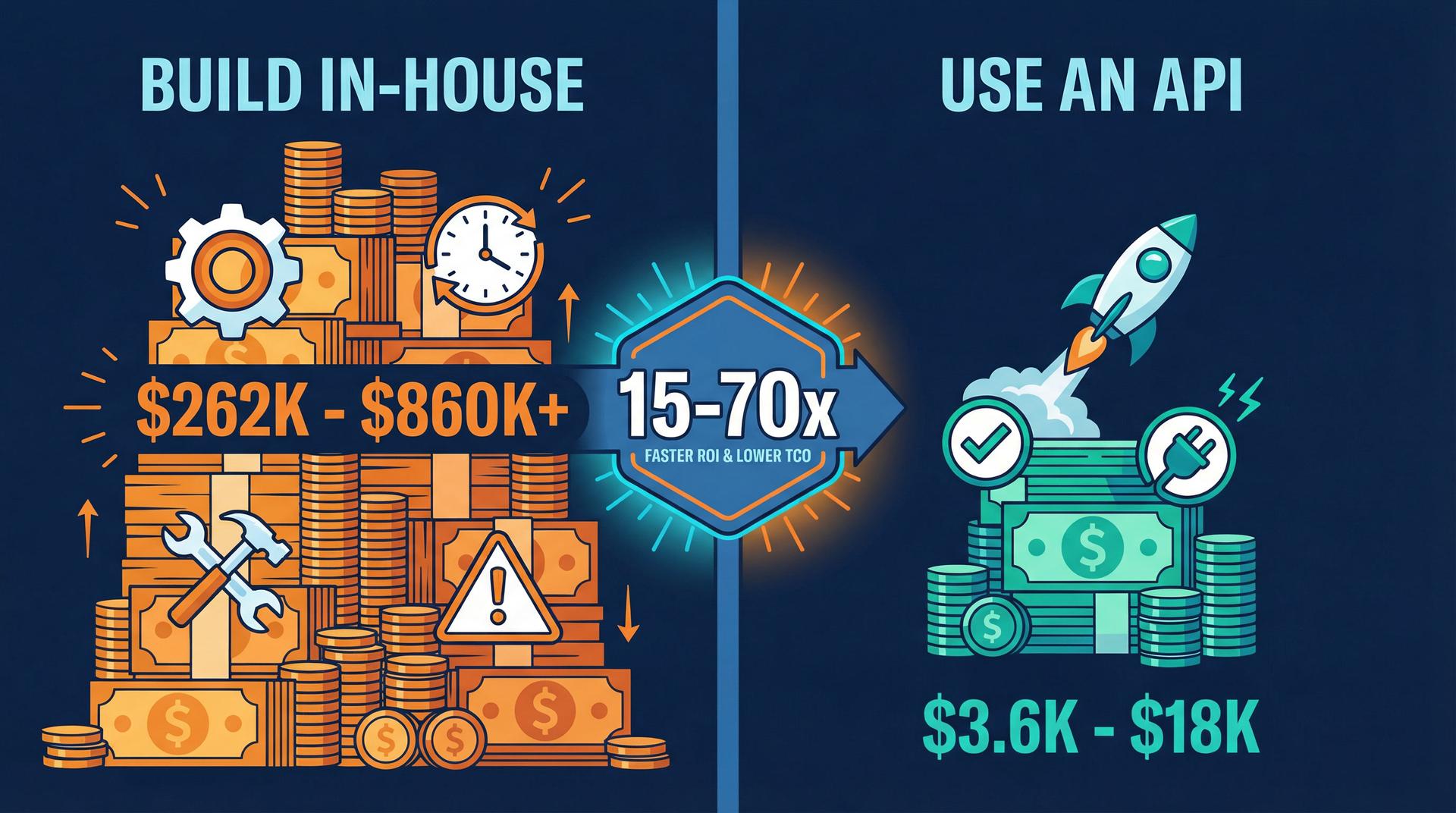
| 3-YEAR TOTAL | $262K - $860K+ | $3.6K - $18K |
The gap is staggering. Even at the low end, building in-house costs 15-70x more than using a gamification API over three years. And this calculation doesn't include opportunity cost -- the revenue and competitive advantage you sacrifice by diverting engineering talent from your core product.
When Building In-House Actually Makes Sense
To be fair, there are scenarios where building custom gamification is the right call:
- Gamification IS your core product. If you're building a gamification platform, a game, or a product where engagement mechanics are the primary value proposition, then yes -- build it. You need deep control over every interaction.
- Extreme regulatory requirements. If you operate in a heavily regulated industry where no third-party vendor can meet your compliance needs, and on-premise deployment with full source code control is legally required.
- Truly unique mechanics. If your gamification system requires mechanics that no existing platform supports and that are deeply coupled with your product's domain logic in ways that can't be abstracted.
For the other 90% of use cases -- adding engagement mechanics to a SaaS product, motivating employees in enterprise tools, or driving retention in an app -- the build-vs-buy equation overwhelmingly favors buying.
Quick ROI Calculator: Do the Math for Your Team
Here's a framework to estimate your own build costs:
| Variable | Your Estimate |
|---|---|
| Number of engineers needed | **_** |
| Average fully-loaded annual salary per engineer | **_** |
| Estimated months to build | **_** |
| Monthly infrastructure cost at your scale | **_** |
| % of engineering time for ongoing maintenance | **_** |
Your Build Cost Formula
Initial Cost = (Engineers x Monthly Salary x Months) + Infrastructure Setup
Annual Maintenance = (Engineers x Annual Salary x Maintenance %) + (Monthly Infra x 12)
3-Year TCO = Initial Cost + (Annual Maintenance x 3)
Now compare that number to a gamification API subscription at $49-$499/month. For most teams, the API costs less than a single week of one engineer's time.
What to Look For in a Gamification API
If you've read this far and the math is pointing you toward buying, here's what to evaluate in a platform:
- Sub-10-minute "Hello World" -- You should be able to integrate basic gamification and see it working in under 10 minutes. If the quickstart guide takes longer than a coffee break, the platform has a developer experience problem.
- Real-time event support -- Batch-processed gamification feels dead. Users expect instant leaderboard updates, immediate achievement unlocks, and live notifications. Look for WebSocket support, not polling.
- Quest and mission systems -- Points and badges are table stakes. Quest systems that guide users through meaningful journeys are what separate effective gamification from superficial implementations.
- Admin console for no-code configuration -- Your product team should be able to adjust XP curves, create new achievements, and modify quest objectives without filing engineering tickets.
- Built-in analytics -- Retention cohorts, activation funnels, and engagement metrics should be available out of the box. You need to measure ROI from day one.
- Transparent, startup-friendly pricing -- Avoid platforms that gate critical features behind enterprise sales calls. Look for self-serve signup, generous free tiers, and usage-based pricing that scales predictably.
- Data portability -- Your data should always be exportable. CSV, JSON, API access -- no vendor lock-in.
Spend Your Engineering Budget Where It Matters
The gamification market is projected to reach $92.5 billion by 2030, driven by proven engagement outcomes across every industry. The demand is real. The mechanics are well-understood. The infrastructure challenge is solved.
The question isn't whether gamification works -- it's whether your engineering team should be the ones building it from scratch.
For the vast majority of SaaS companies, startups, and enterprise teams, the answer is clear: building gamification in-house costs 15-70x more than using a purpose-built API, takes 6-12 months instead of days, creates permanent maintenance burden, and diverts your best engineers from the work that actually differentiates your product.
The $250K question isn't "can we build it?" -- it's "should we?"
Sources: salary data from ZipRecruiter and Glassdoor (2026); infrastructure cost estimates based on Trophy.so's build-vs-buy analysis; gamification market data from Mordor Intelligence, Fortune Business Insights, and Research and Markets (2025-2026); failure rate data from Gartner's original 2012 forecast and subsequent industry analysis; ROI statistics compiled from Centrical, Mambo.io, and Yu-kai Chou's gamification case studies.
Want to skip the $250K build? EngageFabric gives you production-ready gamification -- XP systems, achievements, leaderboards, quests, and real-time events -- with a few lines of code. Start with the free tier and ship engagement features today, not next quarter.