How multi-objective quests transform passive users into power users -- and why most gamification platforms can't offer them.
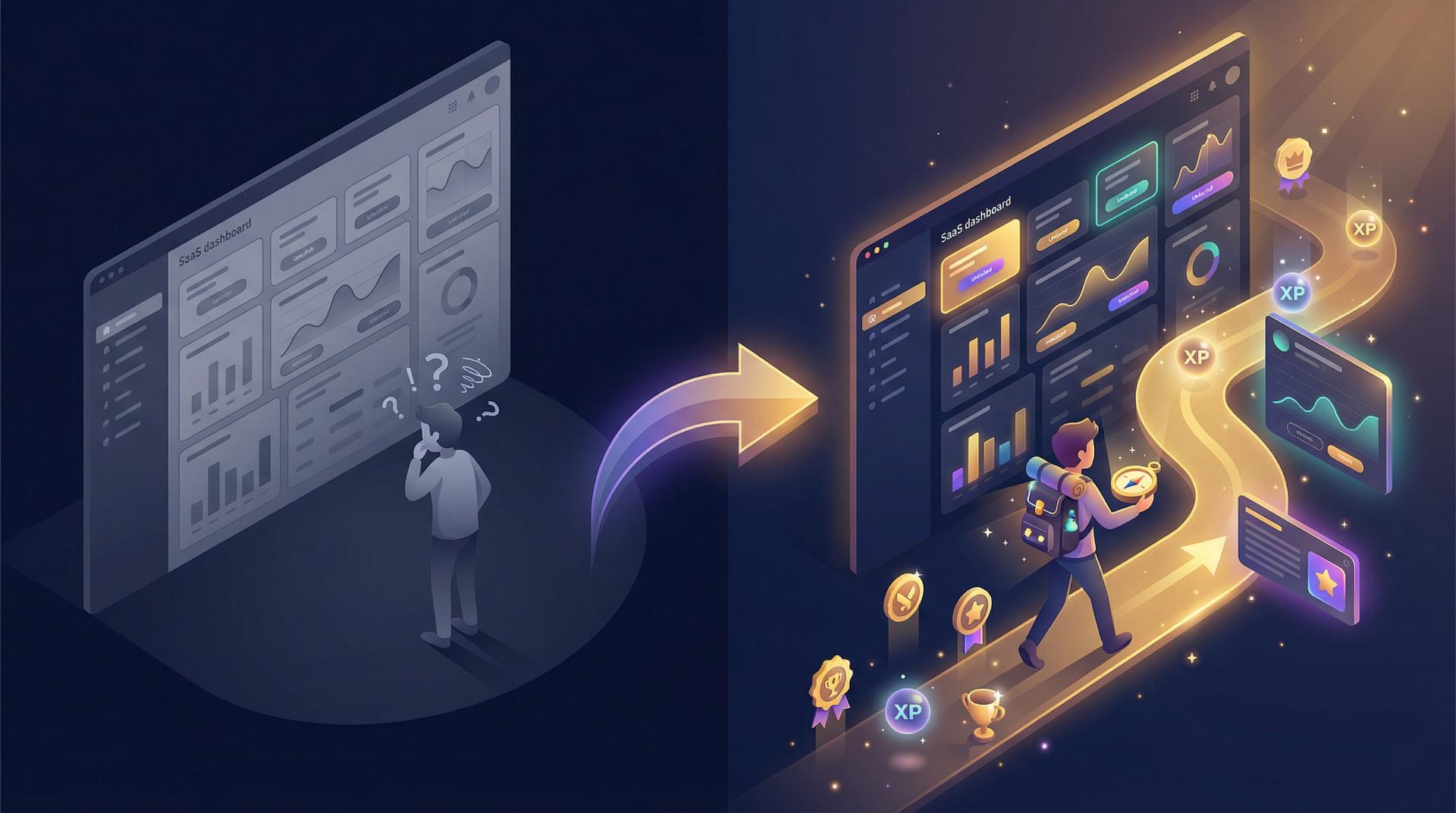
80% of users abandon apps because they don't understand how to use them. Not because the product is bad -- because no one showed them why it matters. Checklists and tooltips help, but they treat onboarding as a task to endure, not a journey to experience.
Quest systems flip that equation entirely.
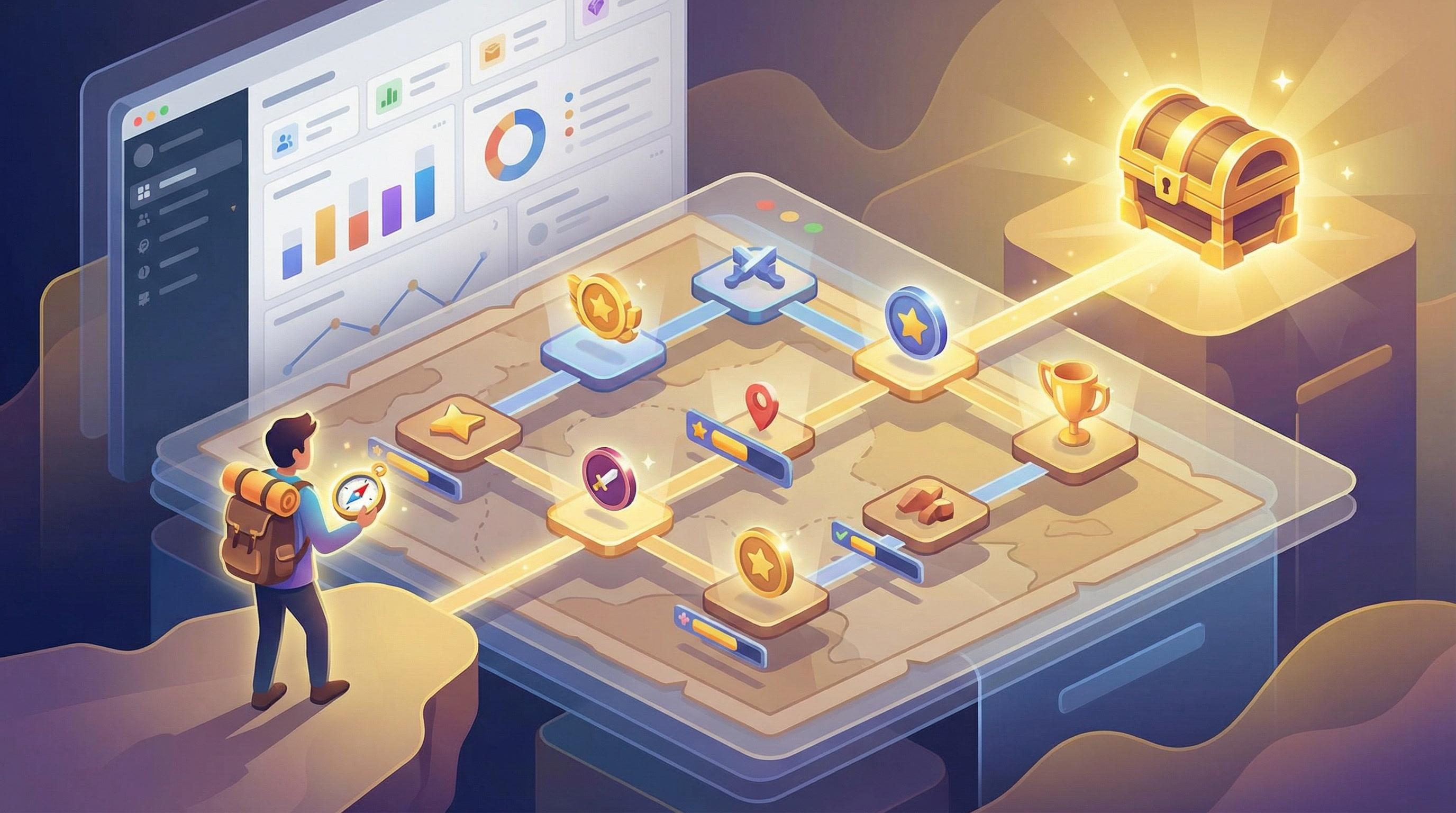
Instead of telling users "click here, then here," quests frame every interaction as meaningful progress toward a goal the user already cares about. Complete three reports? You've unlocked "Data Explorer." Invite your team and finish a sprint? You're on the path to "Collaboration Champion." Each step isn't busywork -- it's guided discovery designed to surface the product's value before users even think about churning.
Duolingo credits their quest system (Daily and Monthly Quests) as a core driver behind their 350% increase in daily active users. Salesforce Trailhead turned an infamously complex CRM into an adventure with quest-like "trails" that millions of users actually enjoy completing. These aren't exceptions -- they're proof that well-designed quest systems work across audiences, from casual consumers to enterprise IT teams.
Yet here's the problem: if you want to build quests into your SaaS product, your options are bleak. Most gamification platforms stop at points and badges. The handful that offer quest-like features lock them behind enterprise contracts or require custom game engine expertise. For the average product team at a growing startup -- or the IT lead trying to boost internal tool adoption -- there's been no practical way to ship a quest system without building it from scratch.
Whether you're a product manager designing your first engagement loop or a growth team optimizing onboarding funnels, this guide covers the design principles behind effective quest systems, how to structure multi-objective and branching quests, when to deploy seasonal content, and how to implement it all without a six-month engineering project.
What Makes Quests Different From Badges and Checklists
Points, badges, and leaderboards (PBL) are the bread and butter of most gamification. They work -- to a point. A badge says "you did the thing." A leaderboard says "here's how you compare." But neither answers the question that matters most for retention: what should I do next?
Quests provide narrative direction. They create a structured path through your product's value, with clear objectives, meaningful milestones, and a sense of progression that goes beyond accumulating a number. The psychological distinction is significant.
Research on self-determination theory -- the most widely cited motivational framework in gamification -- identifies three core human needs: autonomy (feeling in control), competence (feeling capable), and relatedness (feeling connected). Quests uniquely address all three in ways that standalone mechanics cannot.
Autonomy comes from choosing which quest to pursue. Unlike forced onboarding tours, a quest menu lets users select the path that matches their goals. A new marketing manager might pick "Launch Your First Campaign" while a data analyst chooses "Master Custom Reports." Same product, personalized journey.
Competence builds through progressive challenge. Each quest objective is slightly more advanced than the last, creating what psychologists call "flow state" -- that sweet spot between too easy (boredom) and too hard (frustration). Completing an objective delivers immediate feedback that reinforces the user's growing skill.
Relatedness emerges through shared quests and social context. Team quests, guild challenges, and collaborative objectives create the sense that you're part of something larger. When SAP gamified their developer community with mission-based engagement, members who completed collaborative quests contributed significantly more content than those using the platform without quest mechanics.
The practical impact for product teams comes down to one metric: time-to-value. Where a checklist shows users how to use features, quests show them why those features matter in the context of their actual work. That shift from instruction to motivation is what separates products with 20% activation rates from those hitting 70%+.
Quest Design Principles That Actually Drive Retention
Effective quest design borrows from decades of game design research, adapted for the realities of SaaS products where your users have a job to do -- not a dragon to slay. Here are the principles that separate quests users love from quests users ignore.
Principle 1: Anchor Quests to Real User Outcomes
The most common quest design mistake is making objectives about the product instead of the user. "Complete your profile" is a product goal. "Get your first team insight in under 5 minutes" is a user goal. The difference matters because users are motivated by their outcomes, not yours.
Start by mapping your product's "aha moments" -- those critical interactions where users first recognize value. For a project management tool, it might be seeing a Gantt chart auto-update when a task is moved. For an analytics platform, it might be the first custom dashboard that answers a real business question. Design quests that guide users through these moments deliberately rather than hoping they stumble onto them.
Principle 2: Use Progressive Disclosure, Not Information Dumps
Duolingo doesn't reveal leagues, quests, streak freezes, and monthly challenges on day one. They introduce mechanics gradually, when users have enough context to care. This principle of progressive disclosure is critical for quest systems.
Your first quest should be completable in a single session -- ideally under ten minutes. It should require no prior knowledge and reward the user with something tangible: a visible achievement, unlocked functionality, or simply the satisfaction of a completed objective. Subsequent quests can introduce more complexity, longer timelines, and multi-step objectives as users build familiarity with your product.
For enterprise environments, this is particularly important. An IT lead rolling out a new internal tool can't expect employees to engage with a complex quest chain on day one. Start with "Complete your first task" and build toward "Become a department power user" over weeks, not hours.
Principle 3: Make Progress Visible and Irreversible
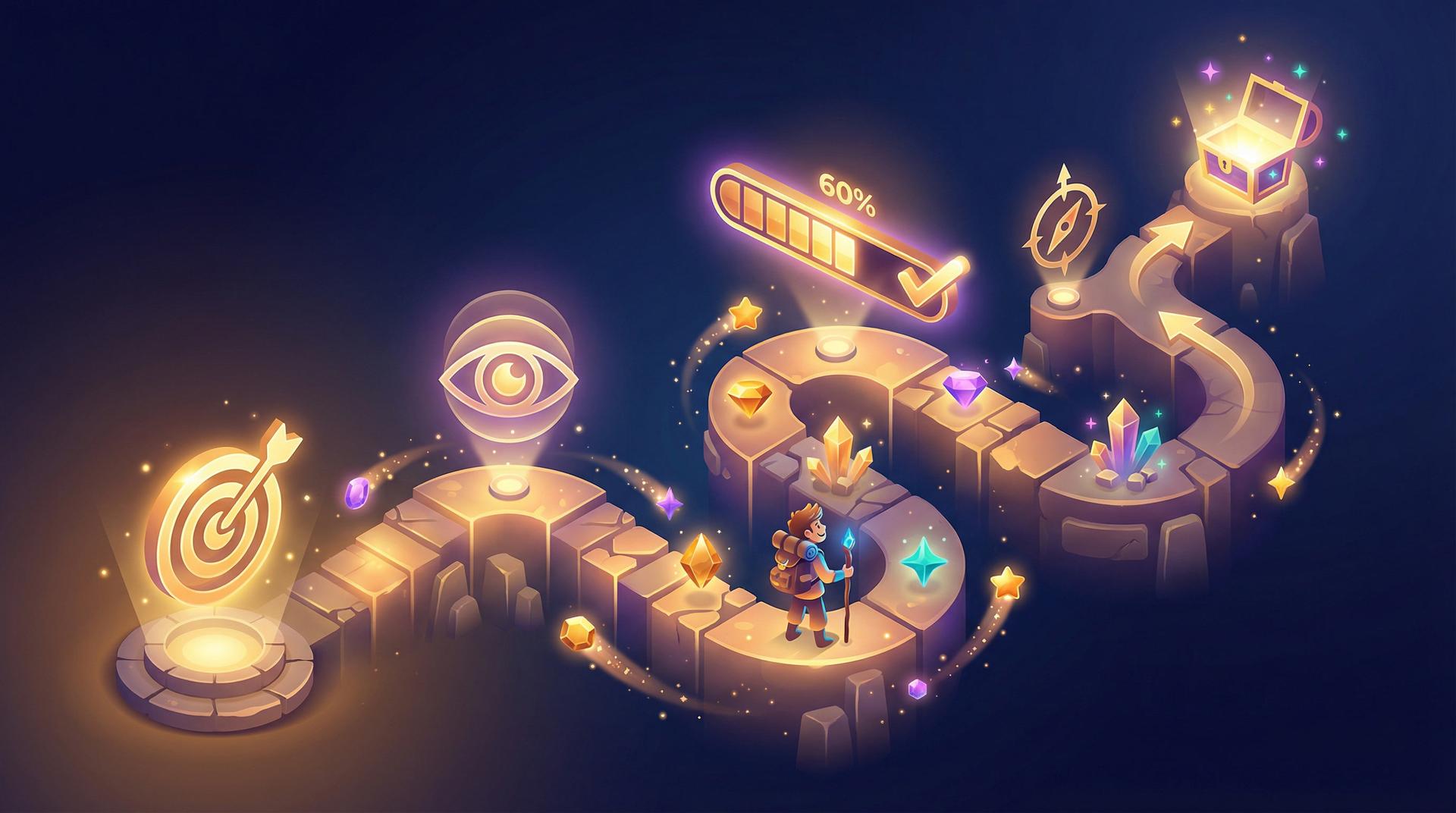
The goal gradient effect -- where people accelerate effort as they approach a finish line -- is one of the most powerful behavioral patterns in gamification. Progress bars, completion percentages, and milestone markers aren't just visual flourishes; they're motivational tools that make goals feel achievable.
Critically, quest progress should feel permanent. If a user completes 3 of 5 objectives and returns two weeks later, that progress must be exactly where they left it. Nothing destroys engagement faster than lost progress. This also means quest systems need robust state management -- tracking per-user, per-quest progress reliably across sessions and devices.
Principle 4: Reward the Journey, Not Just the Destination
Many quest systems make the mistake of placing all rewards at the end. But behavioral science tells us that variable, distributed reinforcement is far more effective at sustaining engagement than a single delayed reward. Think of it this way: if a quest has five objectives, rewards should fire at objectives one, three, and five -- not just five.
These intermediate rewards don't need to be extravagant. XP grants, badge unlocks, progress celebrations, or even just a well-designed notification that says "Nice -- you're halfway through!" keep momentum alive. The key is acknowledgment -- users need to feel that their effort at each step was noticed.
Principle 5: Design for Failure Gracefully
Users will abandon quests. They'll get distracted, priorities will shift, or an objective will feel too difficult. How your system handles this matters enormously.
The worst approach is silence -- a quest sitting in an "in progress" state with no re-engagement mechanism. Better: gentle nudges after inactivity ("You're 60% through 'Analytics Explorer' -- ready to pick it back up?"). Best: adaptive quest systems that offer alternative paths when an objective stalls, or that allow users to swap an objective they're stuck on for a different one of equivalent difficulty.
Multi-Objective Quest Architecture
The real power of quests lies in multi-objective design -- quests that require completing several related actions to achieve a larger goal. This mirrors how people naturally learn and adopt software: not by mastering one feature in isolation, but by connecting multiple features into meaningful workflows.
Linear Quest Chains
The simplest multi-objective structure is a linear chain: complete Objective A, then B, then C. This works well for onboarding quests where the order matters -- you need to create a project before you can add team members, and you need team members before you can assign tasks.
A well-designed onboarding quest chain might look like this:
Quest: "Ship Your First Feature"
- Create a project and give it a name -- 50 XP + "Project Creator" badge
- Invite at least one team member -- 75 XP
- Create and assign three tasks -- 100 XP
- Move a task to "Complete" -- 75 XP + "First Ship" badge
- View your project analytics dashboard -- 100 XP + Quest Complete reward
Each objective builds on the previous one, walking the user through a complete workflow while rewarding them at every stage.
Parallel Objective Quests
For experienced users, linear chains feel constraining. Parallel quests offer multiple objectives that can be completed in any order, giving users the autonomy to choose their own path. This design works particularly well for feature discovery quests.
Quest: "Engagement Toolkit Mastery" Complete any 4 of 6 objectives:
- Configure a custom XP curve
- Set up a time-windowed leaderboard
- Create an achievement with custom criteria
- Define a rules engine trigger
- Build a quest with 3+ objectives
- Connect a webhook to an external service
This "complete X of Y" pattern is powerful because it respects user autonomy while still guiding exploration. Users focus on the features most relevant to them while maintaining a clear path to completion.
Prerequisite Trees
More sophisticated quest systems use prerequisite trees -- where completing one quest unlocks access to the next. This is the model Salesforce Trailhead made famous, and it works exceptionally well for products with deep feature sets.
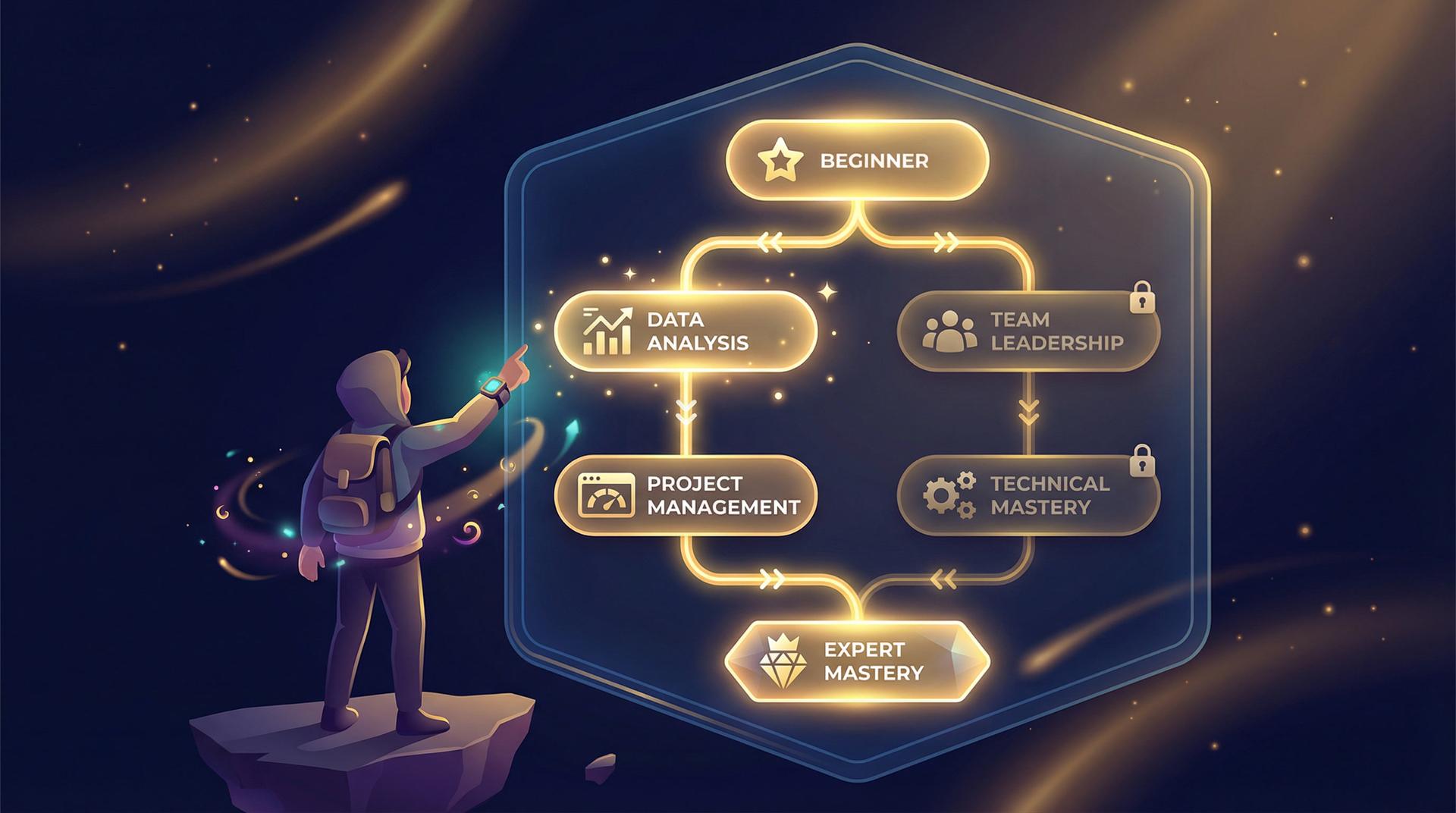
This tree structure means users self-select their learning path based on their role and interests. A product manager might follow the analytics branch while a team lead follows the collaboration branch. Both converge on the "Platform Expert" quest, ensuring comprehensive product adoption regardless of the path taken.
Branching Paths: Personalized Quests at Scale
Branching paths take quest personalization further by adapting the journey based on user actions, roles, or preferences. This is where quest systems become genuinely powerful for B2B products serving diverse audiences.
Role-Based Branching
When a user first enters your product, a simple question -- "What's your primary role?" -- can trigger an entirely different quest experience. A developer sees quests focused on API integration, SDK setup, and webhook configuration. A product manager sees quests around analytics dashboards, rule configuration, and A/B testing. An executive sees quests about reporting, ROI metrics, and team performance.
The underlying quest engine handles the routing: same platform, same feature set, but the quest layer personalizes which features are surfaced first and in what context.
Behavioral Branching
More advanced implementations branch based on what users do, not just what they say. If a user creates three leaderboards before touching achievements, the quest system can infer an interest in competitive mechanics and surface quests related to time-windowed competitions, team leaderboards, and social challenges.
This adaptive approach mirrors how great teachers operate: observe what the student gravitates toward, then guide them deeper into that area before expanding their horizons.
Decision Points
Some quests benefit from explicit decision points where users choose their next step. "You've mastered basic achievements. Choose your next challenge: (A) Create a multi-step quest for your users, or (B) Build a competitive leaderboard season." These decision points increase engagement by giving users ownership over their journey and providing the system with explicit preference signals.
Seasonal and Adventure Content: The Retention Multiplier
While onboarding quests drive initial activation, seasonal and adventure-based content drives the long-term retention that separates sticky products from ones that get used for a week and forgotten.
Adventures (Quest Collections)
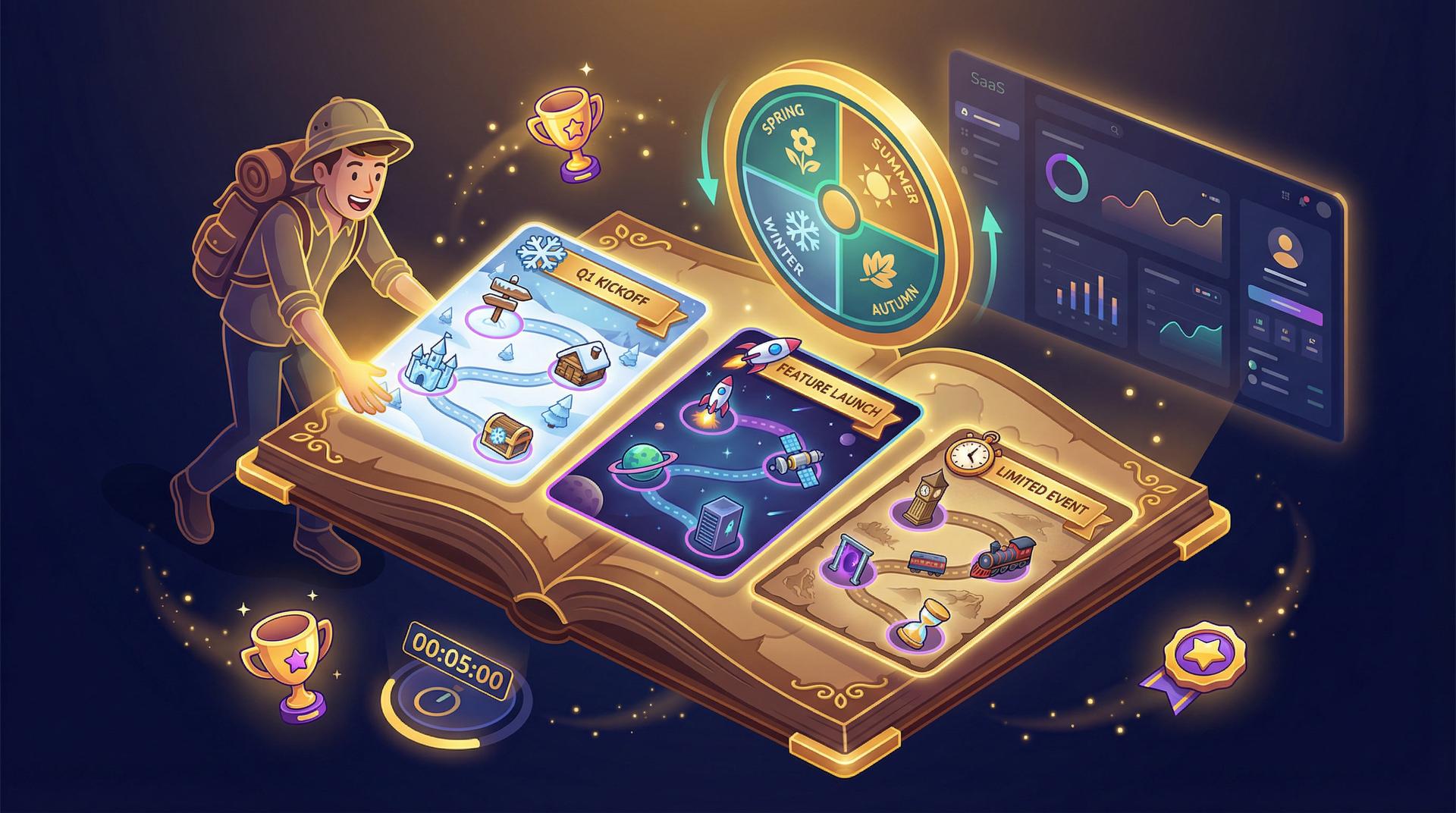
Adventures group related quests into themed collections with overarching narratives. Think of them as "seasons" of content that give users a reason to return after they've completed initial onboarding.
For a B2B SaaS product, adventures might align with business cycles:
- Q1 Adventure: "New Year Kickoff" -- Quests focused on setting up annual goals, configuring fresh leaderboards, and launching team challenges
- Feature Launch Adventure: "Explorer Series" -- Each major product update comes with a quest adventure that guides users through new capabilities
- Industry Adventure: "EdTech Engagement Sprint" -- Vertical-specific quest collections showing how to configure gamification for specific use cases
Adventures create a content calendar for engagement, giving your product team a natural cadence for re-engaging users with fresh quests tied to relevant contexts.
Time-Limited Events
Duolingo's time-limited challenges -- where users earn extra XP or exclusive badges during themed events -- create urgency that drives engagement spikes. This mechanic translates directly to B2B contexts:
- "30-Day Activation Challenge" -- New accounts that complete 10 quests in their first month earn an extended trial or premium feature unlock
- "Community Sprint" -- All users across your platform compete to collectively complete 10,000 quests, unlocking a platform-wide reward
- "Year in Review" -- Annual quests that guide users through their product usage data, celebrating milestones and setting goals for the year ahead
The key is that time-limited events complement, rather than replace, the permanent quest catalog. Users should never feel like they have to engage during a specific window to get value from the quest system.
Why Most Gamification Platforms Can't Do This
Here's the uncomfortable truth about the gamification market: most platforms stop at what the industry calls "PBL" -- points, badges, and leaderboards. These are the easy mechanics to implement and the most commonly requested, so that's where vendors focus.
Quest systems are architecturally different. They require:
- State management per user, per quest, per objective -- tracking granular progress across complex multi-step journeys
- Event-driven evaluation -- listening for specific user actions and evaluating them against quest objective criteria in real time
- Dependency resolution -- managing prerequisite trees, parallel objectives, and branching paths without race conditions or lost progress
- Content lifecycle management -- supporting permanent quests, time-limited events, and seasonal adventures with different activation and expiration rules
- Real-time feedback -- notifying users instantly when objectives are completed, progress is made, or rewards are earned via WebSocket events
Trophy.io, the most developer-focused gamification API on the market, explicitly lacks quest and mission features. Their platform covers achievements, streaks, points, and leaderboards -- strong mechanics, but only part of the engagement story. Enterprise platforms like Mambo.io offer some quest-like functionality, but behind enterprise pricing ($3,000-5,000+/month minimum), lengthy sales processes, and implementation timelines measured in months.
GameLayer offers "missions" but positions them as marketing-oriented campaigns rather than the persistent, progress-tracking quest systems that drive product adoption. Open-source options like Oasis provide foundational gamification but require substantial custom development to support multi-objective quests with branching paths.
For product teams that need quest systems -- particularly at startup-friendly price points with developer-first integration -- the market has a genuine gap.
Implementation: Building Quest-Driven Engagement
If you're building quest functionality yourself, here's the architectural reality of what's involved. If you're evaluating a platform that supports quests natively, this section tells you what to look for.
The Data Model
A quest system requires several interconnected entities:
- Quest Definition -- The template: name, description, objectives, rewards, prerequisites, time constraints
- Quest Objective -- Individual goals within a quest, each with its own criteria, order requirements, and reward
- Player Quest State -- Per-user tracking: which quests are available, in-progress, or completed
- Objective Progress -- Per-user, per-objective progress: current count vs. target, completion timestamp, associated events
- Adventure/Season -- Grouping entity for organizing quests into themed collections with optional time constraints
The Event Pipeline
Quest progress depends on capturing and evaluating user events in real time. When a user completes an action -- creating a project, inviting a teammate, configuring a dashboard -- the event pipeline needs to:
- Receive the event with relevant metadata
- Identify all active quest objectives for that user that could match the event
- Evaluate the event against each objective's criteria
- Update progress counts and check for objective completion
- Check if the parent quest is now complete
- Trigger rewards and notify the user
This pipeline needs to be fast (users expect instant feedback), reliable (lost events mean lost progress), and scalable (thousands of concurrent users generating events simultaneously).
The Integration Point
For a developer integrating a quest system, the ideal experience looks something like this:
// Track a user action — the quest engine handles the rest
await client.events.track({
  playerId: user.id,
  action: 'project_created',
  properties: {
    projectName: 'My First Project',
    template: 'blank',
  },
});

// The quest engine evaluates this event against all
// active quest objectives for this user and automatically:
// - Updates progress on matching objectives
// - Awards XP/badges for completed objectives
// - Sends real-time WebSocket notifications
// - Marks quests complete when all objectives are met
Meanwhile, the quest itself is configured in an admin console -- no code deployment required to create new quests, adjust objectives, modify rewards, or launch seasonal content. This separation of concerns is what makes quest systems manageable at scale: developers handle the event integration once, and product teams iterate on quest content continuously.
Real-Time Feedback
The difference between a good quest system and a great one is the quality of real-time feedback. When a user completes an objective, they should know immediately -- not on the next page load, not after a batch processing job, not when they manually check their progress.
This requires WebSocket infrastructure that pushes updates to connected clients the moment quest state changes. A user completing their third task sees a celebration animation, a progress bar tick forward, and an XP notification -- all within milliseconds of the action. That instant feedback loop is what makes quests feel alive rather than administrative.
Measuring Quest System Success
Implementing quests without measuring their impact is gambling. Here are the metrics that matter:
Quest Completion Rate -- What percentage of users who start a quest actually finish it? Rates below 30% suggest objectives are too difficult, too numerous, or insufficiently rewarding. Rates above 70% suggest the quest might be too easy and should introduce more challenge.
Time to Quest Completion -- How long do users take to complete quests? Compare this against your intended timeline. If an onboarding quest designed for a one-hour session takes users three days, the objectives may be unclear or the product itself may have friction points.
Feature Adoption Correlation -- Do users who complete feature-specific quests actually continue using those features afterward? This is the ultimate measure of whether quests are driving genuine adoption or just gaming behavior.
Retention by Quest Engagement -- Compare 7-day, 30-day, and 90-day retention rates between users who engage with quests versus those who don't. This data justifies continued investment in quest content and helps identify which quest types have the highest retention impact.
Drop-off Analysis -- At which objectives do users abandon quests? This is gold for product teams -- it reveals both quest design issues and product friction points simultaneously.
Getting Started: Your First Quest in Production
You don't need to launch with a complex branching quest tree. Start with a single onboarding quest -- five objectives that walk new users through your product's core value. Measure completion rates, gather feedback, and iterate.
Once that foundation is solid, expand: add a feature discovery quest, a role-based branching path, and your first seasonal adventure. Each addition compounds the engagement effect, creating a self-reinforcing system where users return not because they have to, but because there's always a meaningful next step waiting for them.
The companies that get this right -- Duolingo, Salesforce, HubSpot -- aren't winning because they have more features. They're winning because they guide users through their features in a way that builds genuine skill, visible progress, and lasting habits.
Quest systems are how you turn a product people use into a product people champion.
Ready to add quest-driven engagement to your product without building the infrastructure from scratch? EngageFabric is the gamification API built for developers, with native quest systems, real-time WebSocket events, and an admin console for product teams -- features most competitors simply don't offer.